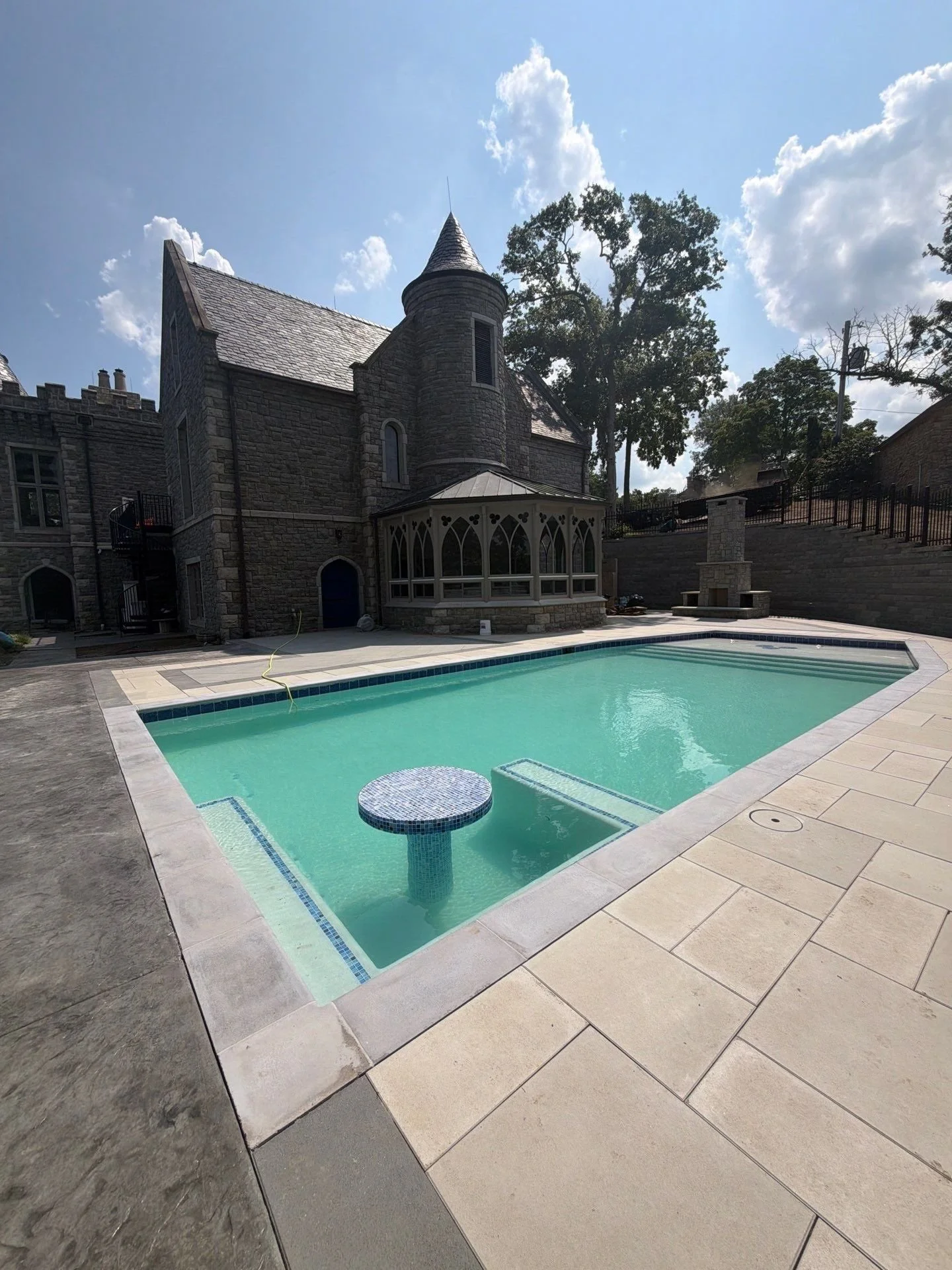
Diagnosis comes before specification on any pool deck resurfacing project in Papillion, NE, because the condition of what is already there decides which finishes remain available.
A homeowner usually arrives at the subject holding a product name, but the more useful starting question is what the existing deck is doing and why it started doing it. Those answers narrow the options long before anyone opens a sample board.
Hardscape Contractors is an award-winning design-build company with locations in Overland Park, KS, Papillion, NE and Brentwood, TN, and our team manages every detail of a project, design through completion, under one roof. Across those projects, the decks that failed a second time were rarely the ones with the wrong color. They were the ones where a coating went over a problem that lived underneath it.
This guide covers how to tell a surface problem from a structural one, what drainage and Nebraska winters contribute, which options a given substrate rules out, and what an honest assessment includes before a number is quoted.
Related: Luxury Backyard Living Starts With the Right Pool Builder in Omaha, NE
What Is Failing on a Pool Deck, the Surface or the Slab?
A pool deck fails either at the surface or in the slab, and those are two different projects with two different prices. A surface problem lives in the top layer: a coating peeling in sheets, a stamped overlay wearing thin at the traffic lines, or a sealed finish that has clouded and lost its grip.
A slab problem shows itself through the surface rather than in it. Cracks that run continuously across several panels, sections sitting at different heights and hollow sounds underfoot point at the concrete and the ground beneath rather than at the finish applied on top.
The distinction matters because a resurfacing product bonds to its substrate and inherits every one of its defects. A quarter-inch overlay laid across a slab that is still moving mirrors that movement within a season or two, and the homeowner has then paid for the same failure twice.
How Do You Read Movement in a Pool Deck?
Movement in a pool deck reads from where the cracks go and what the edges are doing. A hairline crack that stops at a control joint is behaving as the slab was designed to behave, while a crack that crosses a control joint, continues through several panels and reappears on the other side of the pool is following something larger underneath.
Vertical displacement is the clearer signal. Where one side of a crack sits higher than the other, soil beneath the slab has moved, and the common causes around Omaha metro properties are settlement of backfill placed during the original pool construction and water finding a path under the deck.
Backfill deserves particular attention on a pool deck. The ring of ground immediately around a pool shell was excavated and refilled when the pool went in, and where that material was placed without proper compaction it continues to settle for years. Decks poured over it move with it.
What Does Drainage Have to Do With a Failing Pool Deck?
Drainage has a great deal to do with a failing pool deck, and it is the item most often left out of a resurfacing quote. Water carries fines out of the soil beneath a slab, creates the voids that allow settlement, and then freezes in whatever space it occupies.
Deck pitch is the first thing worth measuring. A pool deck is built to shed water away from the coping at a slight fall, and a deck that has settled toward the pool now directs surface water into the joint between deck and coping, which is the most direct route into the backfill ring.
Deck drains and the surrounding grade complete the picture. Blocked channel drains, downspouts discharging onto the deck and planting beds graded toward the pool all deliver volumes of water the structure was not designed to absorb, and resurfacing without correcting those leaves the mechanism of failure fully intact.
Related: Swimming Pool Contractors in Papillion, NE: How to Read Three Proposals That Look Alike
What Do Nebraska Winters Ask of a Pool Deck Surface?
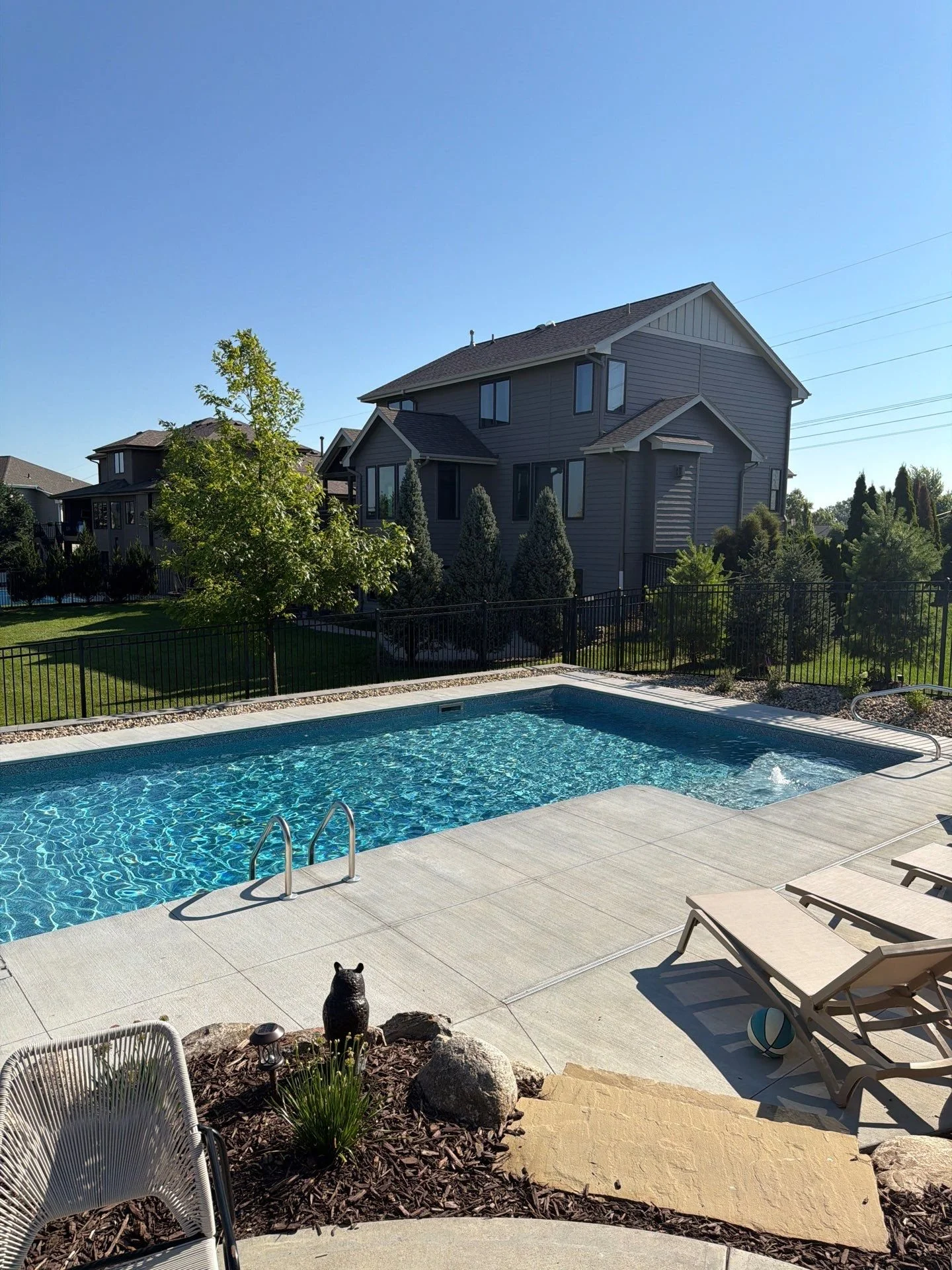
Nebraska winters ask a pool deck surface to tolerate repeated freezing and thawing, which is harder on a pool deck than on most exterior concrete. Water enters the pores of a surface, expands as it freezes and pushes the material apart from within, and through an Omaha metro winter of those cycles a marginal surface begins to scale and spall.
Deicing salt accelerates the same process sharply, and pool decks frequently receive it from an adjacent walk or patio even where nobody applies it directly to the deck. Many coatings and overlays carry explicit limits on salt exposure, and exceeding them voids the finish rather than merely marking it.
Drainage and winter performance are the same question asked twice. A surface that sheds water dries before a freeze, while a surface holding standing water in a low spot delivers the freeze directly into the material, so correcting pitch does more for winter durability than upgrading a product does.
Which Resurfacing Options Does the Existing Slab Rule Out?
The existing slab rules out enough options that the assessment effectively writes the specification. A sound slab with a clean, profiled surface accepts the widest range of treatments, including thin overlays, microtoppings, stamped resurfacing and decorative coatings.
A slab carrying active movement removes the thin options entirely. Where panels are displaced or cracks remain live, bonded toppings telegraph through, and the realistic routes become removal and replacement, or a separate surface placed over a prepared base rather than bonded to the old concrete.
Contamination governs adhesion on an otherwise sound slab. Previous sealers, curing compounds and oils keep a new product from bonding, and the preparation required to remove them is a real line item, so a quote that omits surface preparation is quoting a different job from the one the deck needs.
Paver and natural stone decks follow a separate path again, since the repair is usually a matter of resetting the bedding and the joints. Our outdoor living work rebuilds paver surfaces on a base specified for the soil beneath them.
What Separates a Pool Deck Coating From an Overlay?
Thickness separates a pool deck coating from an overlay, along with what that thickness is able to hide.
A coating is a thin applied film that follows the existing profile exactly, so every ripple, patch and trowel mark in the old slab remains visible through it, and the slab has to be close to the finished appearance already.
An overlay is a cementitious layer with real build, placed thick enough to correct minor irregularities and to carry a stamped or textured pattern. That extra material gives it more capacity to level a surface, and it also makes the bond to the slab beneath far more important.
Service expectations differ accordingly. A coating is the lighter intervention with the shorter cycle before renewal, while a well-bonded overlay on sound concrete behaves much closer to a new surface, so matching the choice to how long the homeowner intends to keep the deck is a sensible filter.
How Much Does Surface Texture Matter Around a Pool?
Surface texture matters enough around a pool to drive the selection on its own in many cases.
A pool deck is walked on by wet bare feet, which puts slip resistance ahead of appearance in any sensible ranking, and smooth polished finishes that photograph beautifully perform poorly in exactly the conditions a pool deck exists to handle.
Surface temperature is the companion issue, and it is regularly underestimated. Dark pigments absorb heat and turn uncomfortable to stand on through a July afternoon in Nebraska, which quietly reduces how often the deck gets used, so lighter tones and textures that hold less heat are a comfort decision rather than a style one.
Cleaning behavior rounds it out. Heavily textured surfaces grip well and also trap debris, sunscreen and organic staining in the profile, so the texture that suits a family with young swimmers differs from the one that suits a deck used mainly for entertaining.
What Should a Homeowner Ask Before Approving Pool Deck Resurfacing?
A homeowner should ask six questions before approving pool deck resurfacing, and the answers reveal whether anyone looked properly.
Ask for the diagnosis of the existing deck in terms of surface against structure, what surface preparation is included, how the existing coating was identified, and what happens to the coping joint during the work.
Then ask about the conditions around it. Find out which drainage corrections are part of this scope and what is excluded, what cure time is required before the deck takes foot traffic and furniture, and what the warranty covers, with particular attention to what it says about salt exposure and movement in the slab.
A proposal that answers those without hesitation reflects a real assessment. One that moves quickly to color charts and a square-foot rate has priced a product rather than a deck.
When Is Pool Deck Replacement the Honest Answer?
Pool deck replacement is the honest answer once the slab has stopped being a reliable base for anything placed on it. Widespread displacement, voids under the concrete, crumbling edges at the coping and cracking that has returned after a previous repair all point the same direction.
Replacement also reopens decisions that resurfacing does not touch. Deck size, the shape of the coping line, pitch, drain positions and the location of steps are fixed once a surface is bonded to the existing slab, and homeowners who have lived with a cramped deck for a decade often want those changed.
The cost gap between the two routes is rarely as wide as people expect once preparation is counted honestly. A heavily prepared slab receiving a premium overlay approaches the figure for a correctly built new deck that carries a longer service life.
How Does Pool Deck Work Interact With the Pool Itself?
Pool deck work interacts closely with the pool itself, which is why a deck is rarely a standalone subject. Coping sits at the junction between deck and pool shell, and the sealant joint behind it is the detail that keeps water out of the backfill, so resurfacing that disturbs that joint has to reinstate it properly.
Skimmer throats, return fittings, light niches and autocover tracks all pass through the deck. Each one has a finished height relationship with the surface, and an overlay that raises the deck by a quarter inch changes how those components sit, so planning for that before the surface goes down avoids awkward corrections afterward.
The condition of the pool itself belongs in the same conversation. Where an interior finish, the coping or the tile line is approaching the end of its service life, sequencing that work with the deck saves doing the same preparation twice.
Our gunite and concrete pools are built with the shell, the coping and the deck treated as one assembly.
What Should a Pool Deck Assessment Include?
A pool deck assessment should include a walk of the full deck with specific things recorded rather than a glance and a price. Crack mapping that notes which cracks cross control joints, measured pitch at several points around the perimeter and the condition of the coping joint all belong in the notes.
Identification of the existing surface matters for adhesion. Knowing what was applied previously, and if a sealer or curing compound is present, determines what preparation the slab requires and whether a bonded product is viable at all.
Water behavior completes it. Where downspouts discharge, how the surrounding grade falls, whether deck drains run clear and where water stands after rain explain why the deck reached its current condition, and a recommendation made without those answers is a guess with a product name attached.
Start Pool Deck Resurfacing in Papillion, NE With an Assessment
A pool deck is a slab sitting on backfilled ground beside a body of water, and the finish on top is the last decision rather than the first. Our team would rather map the cracks, measure the pitch, check the coping joint and find out where the water goes before recommending anything.
Have your pool deck assessed in Papillion, NE by Hardscape Contractors. Schedule your pool deck consultation with Hardscape Contractors.
In Summary
Can a pool deck be resurfaced while the pool stays full?
A pool deck is usually resurfaced with the pool full, provided the pool is covered and protected through the work. Grinding and surface preparation generate dust that must be kept out of the water, and most coatings and overlays require the deck to stay dry for a defined cure period. Where coping or the sealant joint is being replaced, lowering the water line below that joint is sometimes necessary for a few days.
What time of year suits pool deck work in Papillion, NE?
Pool deck work in Papillion, NE suits late spring through early fall, because nearly every overlay, coating and sealant carries a minimum application temperature and a cure window that Nebraska winters interrupt. Scheduling tends to fill quickly once the swimming season opens, so assessments carried out over the winter generally secure an earlier slot.
Does resurfacing fix a crack that keeps coming back?
Resurfacing alone does not fix a crack that keeps coming back. A crack that has returned after a previous repair is reporting movement in the slab or the ground beneath it, and a bonded surface laid over it reflects that movement again. The durable route is to establish what is moving, correct the cause where it is drainage or a void, and then choose between a surface that tolerates the remaining movement and replacing the affected concrete.
What happens after a pool deck assessment?
After a pool deck assessment, Hardscape Contractors follows up with a written recommendation and options rather than a number offered on the spot. Identifying an unknown existing coating occasionally takes a small test patch, so the recommendation reflects what the slab will actually accept.
Related: Elkhorn and Valley, NE: Hiring Premier Pool Companies to Craft a Summer Retreat